Principal Office
15110 Dallas Pkwy #400
Dallas, TX 75248
(972) 233-5700
15110 Dallas Pkwy #400
Dallas, TX 75248
(972) 233-5700
15110 Dallas Pkwy #400
Dallas, TX 75248
972-233-5700
Years Defending Texans
Cases Dismissed
Criminal Cases Handled
Counties Served Across Texas
Available | Serving All of Texas
When your child faces juvenile charges in Texas, the emotional weight can feel overwhelming. At Law Offices of Richard C. McConathy, we understand the unique challenges families face during these difficult times.
Our experienced Arlington juvenile defense attorneys provide compassionate counsel while aggressively protecting your child’s future.
With extensive local court experience and a proven track record of successful juvenile case outcomes, we guide families through every step of the process.
Contact us immediately at (972) 528-0478 for dedicated juvenile criminal defense.
Our lead attorney is also a seasoned criminal defense lawyer in Arlington, giving your family the advantage of comprehensive legal experience.
The Texas juvenile justice system operates differently from adult criminal courts, focusing on rehabilitation rather than punishment. However, juvenile charges can still carry serious consequences that may impact your child’s education, employment opportunities, and future prospects. Understanding the charges your minor faces is the first step toward building an effective defense strategy.
Our Arlington juvenile lawyers have successfully defended minors against a wide range of criminal charges:
Theft Charges: Including shoplifting, burglary, and unauthorized use of motor vehicles. These cases often involve peer pressure situations where good kids make poor decisions.
Drug Possession: Marijuana possession remains the most common drug-related juvenile charge in Texas. We’ve helped numerous families navigate these cases while protecting their child’s educational opportunities.
Vandalism and Criminal Mischief: Property damage cases that frequently occur during unsupervised gatherings or as pranks that went too far.
Assault and Fighting: School altercations or neighborhood disputes that escalate beyond verbal disagreements.
Underage DUI: Driving while intoxicated charges for minors, which carry unique penalties different from adult DWI cases.
Texas juvenile courts prioritize rehabilitation over punishment, but this doesn’t mean the stakes are low. Key differences include:
| Juvenile Court | Adult Court |
|---|---|
| Focus on rehabilitation | Focus on punishment |
| Sealed or confidential records | Public criminal records |
| Judge makes all decisions | Jury trials available |
| Probation and treatment programs emphasized | Incarceration more common |
| Records may be expunged | Permanent criminal record |
The moment police arrest your child, several critical decisions unfold rapidly. Arlington police may detain your minor at the Tarrant County Juvenile Detention Center (2701 Kimbo Road, Fort Worth) or release them to parents with a citation to appear. If your child is held at the detention center, visiting hours are from noon to 7:45 PM Monday through Friday and 10 AM to 5:45 PM on weekends. You have the right to contact an attorney immediately – and you should exercise this right without delay.
Within 48 hours (excluding weekends and holidays), the intake officer at Tarrant County Juvenile Services reviews the case and determines whether to file a petition, refer your child to a diversion program, or dismiss the charges entirely. Having experienced legal representation at this stage significantly improves outcomes. We know the intake officers personally and understand which arguments resonate with each one.
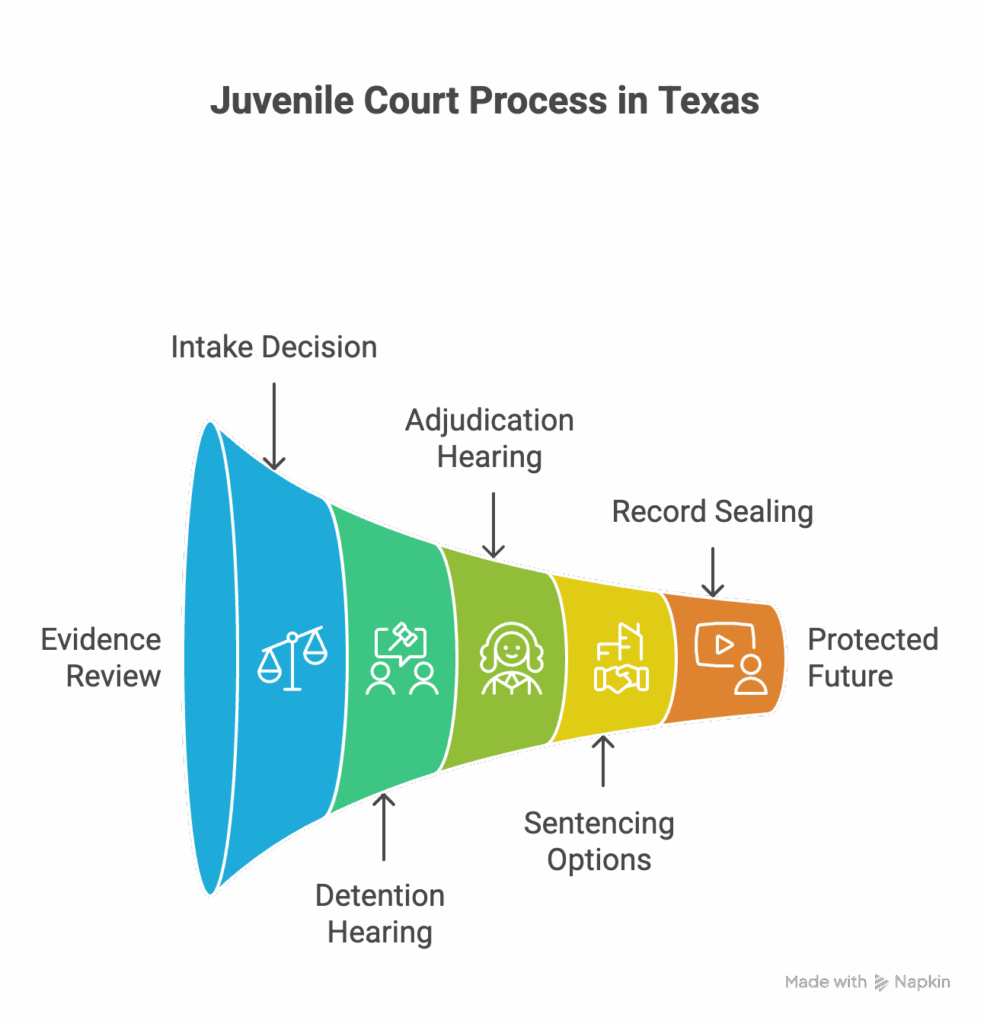
Navigating the Texas juvenile court system requires understanding its unique procedures and timelines. Each stage presents opportunities for skilled attorneys to protect your child’s interests while working toward the best possible outcome.
Intake Process:
The Tarrant County Juvenile Services department, located at 2701 Kimbo Road in Fort Worth, reviews all evidence and decides whether formal charges are warranted. This critical stage often determines whether your case proceeds to court or gets resolved through alternative programs.
Detention Hearings:
If your child remains in custody at the Tarrant County Juvenile Detention Center, a judge must determine within 48 hours whether continued detention is necessary. Parking at the juvenile courthouse can be challenging during peak hours – we recommend arriving 30 minutes early for detention hearings. We advocate aggressively for your minor’s release to family custody whenever possible.
Adjudication:
These hearings take place at the Tim Curry Criminal Justice Center at 401 W Belknap Street in Fort Worth, easily accessible from Arlington via I-30 West. Unlike adult proceedings, no jury exists in juvenile court – the judge makes all determinations based on evidence presented. The building requires security screening, so arrive early.
Texas juvenile courts offer various disposition options designed to rehabilitate rather than punish:
Protecting your child’s future means understanding record sealing options. Texas law allows many juvenile records to be sealed or expunged, effectively erasing them from public view. Our attorneys guide families through this process, ensuring your minor’s mistakes don’t follow them into adulthood.
Eligible cases can be sealed immediately upon successful completion of probation or dismissed charges. This protection preserves college admissions, scholarship opportunities, and future employment prospects.
Facing juvenile charges without experienced legal representation puts your child’s future at unnecessary risk. The consequences of inadequate defense can follow your minor for years, affecting everything from college applications to job opportunities.
Our Arlington juvenile defense team has appeared before every judge in the Tarrant County juvenile courts. We understand each judge’s sentencing preferences and which alternative programs they favor.
The 323rd District Court, which handles juvenile cases, is currently presided over by Judge Alex Kim, who has implemented significant reforms including reducing case resolution times and maintaining focus on rehabilitation-based outcomes.
Our relationships with juvenile prosecutors in the District Attorney’s office enable productive negotiations that often result in reduced charges or alternative dispositions. We know which prosecutors are receptive to diversion programs and how to present cases most effectively to each individual prosecutor.
Our experience with local prosecutors enables productive negotiations that often result in reduced charges or alternative dispositions that protect your child’s future.
Every decision we make considers your child’s long-term interests. While some attorneys focus solely on avoiding immediate penalties, we develop strategies that protect educational opportunities, scholarship eligibility, and future employment prospects.
Our approach includes:
Negotiating for charges that won’t impact college admissions or financial aid eligibility.
Pursuing record sealing or expungement options whenever possible.
Coordinating with school officials to minimize educational disruption.
Working with college admissions counselors when necessary to explain resolved juvenile matters.
Juvenile cases affect entire families, not just the accused minor. We recognize the emotional toll these situations create and provide support for parents while developing aggressive defense strategies for your child.
We explain legal concepts in plain language, keep families informed throughout the process, and remain available for questions or concerns. We treat every family with the respect and attention they deserve during these challenging times.
For comprehensive information about our criminal defense services in Arlington, explore how our experienced team handles all types of criminal cases throughout Tarrant County.
Effective juvenile defense requires immediate action and strategic thinking. Our Arlington attorneys begin building your child’s defense from the moment you contact our firm, focusing on early intervention and alternative resolution options.
The sooner we enter your case, the more options remain available. Early intervention often prevents formal charges from being filed, keeping your child’s record completely clean.
We immediately contact the intake officer and prosecutor to discuss the case facts, your child’s background, and potential alternative resolutions. This proactive approach demonstrates your family’s commitment to addressing the situation responsibly.
Many juvenile cases can be resolved without formal court proceedings. Texas law provides several pre-trial intervention options that keep cases out of the juvenile justice system entirely.
These alternatives include:
Diversion programs offer second chances for minors who make mistakes but don’t pose ongoing threats to community safety. These programs focus on education, counseling, and skill-building rather than punishment.
Our attorneys evaluate every client for diversion eligibility and advocate aggressively for program acceptance. Successful completion typically results in complete case dismissal, leaving your child’s record clean.
Treatment-focused approaches work particularly well for cases involving substance abuse, anger management issues, or family conflicts. We connect families with appropriate resources while demonstrating to prosecutors that your child is receiving necessary help.
When formal charges cannot be avoided, skilled negotiation often reduces penalties significantly. Our experience with local prosecutors enables productive discussions about appropriate dispositions for each unique case.
We present comprehensive mitigation packages that include:
Through skilled negotiation, we work to secure favorable outcomes that protect your child’s future opportunities.
Juvenile cases impact entire families, creating stress and uncertainty that extends far beyond the accused minor. Our Arlington legal team provides comprehensive support for parents while zealously advocating for your child’s best interests.
The juvenile justice system can feel confusing and overwhelming for parents experiencing it for the first time. We take time to explain each step clearly, ensuring you understand what’s happening and what comes next.
Long-Term Consequences: How different outcomes affect your child’s educational opportunities, employment prospects, and future goals.
Juvenile arrests don’t happen on convenient schedules. When police arrest your child, you need immediate legal guidance to protect their rights and make informed decisions.
Our firm provides 24/7 contact availability for current clients facing emergency situations. Whether your child is arrested on a weekend, during holidays, or in the middle of the night, we’re available to provide immediate guidance and begin building their defense.
This includes emergency detention hearing preparation, immediate contact with juvenile intake officers, coordination with bail bondsmen when necessary, and crisis counseling referrals for families struggling with the emotional impact of arrest.
The decisions made during juvenile proceedings can impact your child for decades. Our attorneys focus on long-term protection, not just immediate case resolution.
We pursue every available option for keeping your child’s record clean through record sealing, expungement, deferred disposition, and non-disclosure orders. These protections preserve college admissions, scholarship opportunities, and future employment prospects.
Your child’s future depends on the decisions you make right now. Every day you wait to contact an experienced Arlington juvenile defense attorney reduces the options available for protecting your minor’s interests.
At Law Offices of Richard C. McConathy, we understand the fear and uncertainty you’re experiencing. Our experienced team has successfully defended hundreds of juvenile cases throughout Tarrant County, and we’re ready to put that experience to work for your family.
Contact our Arlington office immediately at (972) 528-0478 for dedicated juvenile criminal defense. We offer free initial consultations and are available 24/7 for emergency situations.
Contact our office today to discuss your child’s case with an experienced Arlington juvenile defense attorney. Time is critical – let us start building your defense immediately.
When Texas authorities charge a minor with a crime, the case enters the juvenile justice system rather than adult criminal court. The process begins with intake evaluation by juvenile probation officers who determine whether formal charges are appropriate.
Your child may be detained temporarily or released to parental custody pending further proceedings. The key difference from adult court is the focus on rehabilitation rather than punishment, though serious consequences still apply.
Early legal representation significantly improves outcomes. Our Arlington juvenile attorneys intervene immediately to protect your child’s rights and explore alternatives to formal prosecution.
Yes, Texas law allows certain juvenile cases to be transferred to adult court under specific circumstances. This process, called “certification” or “waiver to adult court,” typically applies to serious felony charges committed by older juveniles.
Factors courts consider include:
Transfer to adult court carries severe consequences, including potential adult sentencing, permanent criminal records, and adult correctional facilities. Our attorneys fight aggressively against certification motions when they arise.
Juvenile records can impact your child’s future opportunities despite common misconceptions about their confidentiality. While juvenile records receive more protection than adult criminal records, they’re not automatically invisible.
Potential consequences include:
Our attorneys work diligently to minimize these long-term consequences through record sealing, expungement, and strategic case resolution.
Texas juveniles are typically housed in specialized detention facilities rather than adult jails. In Tarrant County, minors are held at the Juvenile Detention Center on Kimbo Road, which focuses on education and counseling rather than punishment.
Most Arlington minors remain in their communities through probation, alternative programs, or release to parental custody. The facility provides educational services through Arlington ISD teachers and offers family visitation twice weekly.
Detention typically occurs only when:
What to expect during detention: Your child will receive a medical screening within 24 hours, access to educational programming through Fort Worth Independent School District, and regular contact with juvenile probation officers. Each juvenile gets a daily 5-minute phone call with parents and 30-minute daily visitation opportunities with immediate family members.
Our attorneys advocate aggressively for community-based alternatives that keep your child at home while addressing the underlying issues that led to their arrest.
Texas law provides several options for clearing juvenile records, depending on your child’s specific circumstances and the outcome of their case.
Automatic Sealing: Records are automatically sealed for many first-time misdemeanor offenses upon successful probation completion.
Petition for Sealing: More serious cases may require formal court petitions demonstrating your child’s rehabilitation and changed behavior.
Expungement: Complete record destruction is available for dismissed charges, not-guilty findings, and certain successfully completed programs.
Timing varies by case type and outcome. Our attorneys evaluate every client’s record sealing eligibility and guide families through the appropriate process at the right time.
The process typically takes 60-90 days and requires detailed documentation of your child’s current circumstances, community involvement, and evidence of rehabilitation.
3710 Rawlins St Ste 1408, Dallas, TX 75219
Mon. 9 AM – 5 PM
Tue. 9 AM – 5 PM
Wed. 9 AM – 5 PM
Thu. 9 AM – 5 PM
Fri. 9 AM – 5 PM
Sat. – Closed
Sun. – Closed
The information provided on this site is for general information purposes only. The information you obtain at this website is not, nor is it intended to be, legal advice. You should consult an attorney for advice regarding your own individual situation. We invite you to contact us and welcome your calls, letters and electronic mail. Contact Us today for more information.
The hiring of a Dallas-Fort Worth criminal defense attorney in Texas is an important decision that should not be based solely upon advertisements, informational videos, or an internet website. Before you decide which attorney to hire for your case, ask us to send you free additional written information about our qualifications and experience.
Sitemap | Privacy Policy | Terms of Service
Copyright © 2021-2024 Law Offices of Richard C. McConathy
LAW FIRM MARKETING BY WEBRIS
Whether you're facing a felony charge or fighting a traffic ticket, every case deserves serious attention. Get an experienced defense team in your corner now.