Drug arrests in Dallas rarely tell the whole story. Police reports summarize events in a few pages, but those reports do not answer every question about how officers conducted the stop, how evidence changed hands, or whether prosecutors possess enough proof to support the charge.
Dallas Drug Defense Lawyers at the Law Offices of Richard C. McConathy defend people accused of drug crimes throughout Dallas County and North Texas. Since 2002, the firm has focused primarily on criminal defense and has handled more than 6,000 criminal cases.
Facing drug charges in Dallas? Schedule a free consultation with our experienced criminal defense attorney to protect your rights and build your defense!
Why Do People Hire McConathy Law for Dallas Drug Charges?
People hire McConathy Law because drug prosecutions depend on evidence, and evidence deserves close examination. Police officers, crime laboratories, and prosecutors all play a role in building a case. Each step creates opportunities for mistakes.
Richard McConathy has spent decades defending criminal cases across North Texas. His background includes membership in the Texas Criminal Defense Lawyers Association and the Dallas Criminal Defense Lawyers Association, along with service as Treasurer of the Dallas Bar Association Criminal Law Section.
Call 972-233-5700 for a free case evaluation or fill out our contact form.
Experience With Dallas County Drug Prosecutions
Drug prosecutions in Dallas County begin long before a case reaches trial. Investigators rely on traffic stops, search warrants, confidential informants, surveillance, and laboratory testing to build their cases.
Most felony drug cases proceed through the Frank Crowley Courts Building, where criminal district courts handle matters involving possession, delivery allegations, and other controlled substance offenses.
Dallas County prosecutors review police reports, body camera footage, laboratory testing, and witness statements before deciding how to proceed. Understanding how those cases develop inside Dallas County helps shape defense strategy from the beginning.
Our office handles cases involving:
- Marijuana charges
- Cocaine and methamphetamine allegations
- Prescription drug offenses
- Possession with intent to deliver accusations
- Federal drug prosecutions
Every case deserves an independent review because accusations alone do not establish guilt.
How Drug Cases Move Through Dallas County
Drug cases in Dallas County rarely resolve immediately. Most cases involve multiple court settings, discovery, and laboratory testing before prosecutors and defense attorneys fully evaluate the evidence.
Felony cases move through the Frank Crowley Courts Building. Prosecutors review:
- Police reports
- Body camera recordings
- Search warrants
- Laboratory analysis
- Witness statements
- Digital evidence
Laboratory testing delays and discovery issues sometimes affect the pace of a case. Questions regarding searches, chain of custody, and witness credibility often become important long before a jury trial.
Understanding how Dallas County courts handle these cases helps attorneys identify issues that may affect the strength of the prosecution.

What Drug Charges Do Dallas Drug Defense Lawyers Handle?
Dallas Drug Defense Lawyers defend misdemeanor and felony cases involving controlled substances under the Texas Health and Safety Code.
Texas classifies controlled substances into penalty groups. The type of substance and the amount involved influence the range of punishment.
Felony Allegations Carry Higher Stakes
Felony drug convictions affect more than jail exposure. A conviction creates consequences involving employment opportunities, professional licenses, housing applications, and firearm rights.
Many clients seek representation because they want to protect opportunities that extend far beyond the courtroom.
How Does Texas Law Define Drug Possession?

Texas law requires prosecutors to prove more than proximity to a controlled substance. The state must establish knowledge, care, custody, or control.
Texas prosecutions revolve around the penalty group assigned to the substance. Cocaine, methamphetamine, heroin, fentanyl, and many prescription medications fall into different penalty groups under Chapter 481 of the Texas Health and Safety Code. The penalty group and the amount involved largely determine whether prosecutors file a misdemeanor or felony case.
Simply being present near drugs does not automatically establish possession.
Constructive Possession Cases
Constructive possession refers to cases where drugs appear in locations shared by several people. Prosecutors must connect the accused person to the substance through independent evidence.
Examples include:
- Vehicles occupied by multiple passengers
- Shared apartments or houses
- Hotel rooms with several occupants
- Property belonging to another person
- Public places with multiple people present
Constructive possession cases generate factual disputes because ownership and possession are separate concepts.
Why Possession Cases Become Complicated
Police officers draw conclusions during an investigation, but conclusions are not evidence. Jurors examine facts, testimony, forensic results, and credibility when deciding guilt.
Those distinctions create opportunities for defense arguments.
Can Illegal Searches Lead to Dismissal?
Yes. Illegal searches create grounds for suppression motions that remove evidence from a criminal case.
The Fourth Amendment to the United States Constitution protects people against unreasonable searches and seizures. Official text appears through the National Archives.
Texas law also recognizes constitutional protections during criminal investigations.
Traffic Stops Receive Close Review
Many Dallas drug arrests begin with a traffic stop. A defense attorney reviews the reason for the stop and examines what happened afterward.
Questions commonly include:
- Did officers possess reasonable suspicion?
- Did police prolong the stop without justification?
- Did consent play a role in the search?
- Did officers obtain a warrant when required?
- Did body camera footage match the report?
Constitutional issues shape the strength of a prosecution. Evidence obtained unlawfully faces suppression challenges.
Search Warrants Require Precision
Search warrants in Texas are governed by Chapter 18 of the Texas Code of Criminal Procedure, which establishes procedures for issuing and executing warrants.
Judges issue warrants based on affidavits presented by law enforcement officers. Those affidavits must contain sufficient facts. Errors involving warrants create disputes regarding probable cause and the scope of the search.
Our experienced drug crime attorneys are here to provide a free consultation and a strong defense strategy. Contact us for support and expert guidance!
Why Do Intent to Deliver Charges Face Challenges?
Intent to deliver cases depend heavily on circumstantial evidence. Circumstantial evidence refers to proof that requires inferences instead of direct observations. Prosecutors rely on surrounding facts to argue distribution rather than personal use. Evidence that could be used during a case include: digital scales, cash, plastic baggies, cell phones, and text messages.
Objects alone do not establish criminal intent. Context influences how juries interpret evidence.
Quantity Does Not Automatically Prove Distribution
Drug quantity plays a role, but prosecutors still carry the burden of proving intent.
Defense attorneys examine innocent explanations, challenge assumptions, and evaluate whether the evidence supports the allegations.
Why Laboratory Testing Matters in Dallas Drug Cases
Many drug prosecutions depend on chemical analysis. Prosecutors must prove the identity of the substance, not simply rely on appearance or assumptions.
Evidence collected in Dallas County is frequently submitted to the Southwestern Institute of Forensic Sciences (SWIFS) for analysis. Laboratory reports, chain of custody records, and testing procedures all become important issues during a criminal case.
Chain of Custody Problems
Chain of custody refers to the documentation showing who handled evidence and when. Missing information creates questions regarding reliability.
Common Evidence Issues
Forensic evidence deserves careful review.
- Incomplete laboratory reports
- Storage problems
- Documentation errors
- Mishandled evidence
- Gaps in chain of custody
Cases involving forensic weaknesses raise questions about whether prosecutors possess reliable proof.
What Happens When Federal Authorities File Drug Charges?
Federal prosecutions follow different rules than state cases. Federal investigators spend months building cases before making arrests. The United States Sentencing Guidelines influence punishment and create a different landscape than Texas state courts. Federal cases move differently than state prosecutions, which makes early case preparation particularly important.
What Evidence Do Prosecutors Use in Dallas Drug Cases?
Dallas drug prosecutions rise and fall on evidence. Prosecutors must prove more than the existence of a substance. They must connect that substance to a person, establish how law enforcement obtained it, and show that laboratory testing supports the allegations.
Drug cases filed at the Frank Crowley Courts Building rarely depend on a single piece of proof. Prosecutors build cases by combining physical evidence, officer testimony, video footage, laboratory reports, text messages, and witness statements. Each category of evidence presents its own weaknesses.
Common Evidence Used in Dallas Drug Charges
| Type of Evidence | What Prosecutors Try to Show |
| Controlled substances | Existence of illegal drugs |
| Laboratory reports | Identity of the substance |
| Officer testimony | Circumstances of the arrest |
| Body camera footage | Statements and conduct |
| Text messages | Intent to deliver allegations |
| Social media records | Communications and relationships |
| Cell phone location data | Presence and movement |
| Witness testimony | Knowledge or possession |
| Cash, scales, and baggies | Distribution activity |
The prosecution's theory depends on the combined weight of the evidence rather than on one isolated fact.
Physical Evidence Does Not End the Case
Jurors tend to assume that drugs recovered during an arrest automatically prove guilt. Texas law imposes a much higher burden.
The state still must establish who exercised control over the substance and whether the accused knew the substance existed. Those questions become difficult when drugs appear inside a vehicle occupied by several people or inside an apartment shared by roommates.
Cases involving constructive possession generate disputes that go far beyond the location where officers discovered the evidence.
Digital Evidence Plays a Larger Role Than Many Defendants Expect
Modern prosecutions extend well beyond plastic bags and laboratory reports. Investigators increasingly rely on text messages, social media accounts, photographs, location information, and search histories.
Prosecutors use digital evidence to support allegations involving delivery, distribution, or conspiracy. Defense attorneys examine whether law enforcement obtained that information legally and whether the records actually support the conclusions the State hopes to draw.
A text message without context tells only part of the story.
Why Do Body Camera Videos Matter in Dallas Drug Cases?
Body camera footage has changed how drug cases get evaluated. Dallas police officers and many surrounding agencies routinely record traffic stops, searches, and arrests. Those recordings sometimes support the police report, but they also expose inconsistencies.
A written report summarizes events through the officer's perspective. Video captures tone, timing, statements, and the sequence of events. Those details matter when constitutional issues arise.
Video Evidence Reveals Details Reports Leave Out
Body camera footage provides information that does not always appear in arrest reports.
Defense attorneys review recordings to determine whether officers extended a traffic stop without legal justification, whether consent appeared voluntary, and whether witness statements changed during the encounter. Footage also helps establish whether officers followed department procedures during the investigation.
In some cases, video evidence becomes more persuasive than testimony because jurors see events unfold with their own eyes rather than relying entirely on memory.
Missing Video Creates Questions
Not every encounter gets recorded completely. Cameras malfunction, recordings become unavailable, or only portions of an incident appear on video.
Missing footage does not automatically defeat a prosecution. Still, the absence of recordings sometimes raises questions about what happened before an arrest and why certain evidence never appears on camera.
Cases involving incomplete recordings require attorneys to compare reports, witness statements, dispatch logs, and other evidence to reconstruct the sequence of events.
Why Does Chain of Custody Matter in Drug Cases?
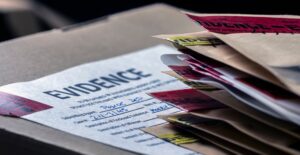
Chain of custody refers to the documentation showing who handled evidence and when. Prosecutors must establish that the substance presented in court matches the substance officers originally seized.
Evidence passes through numerous hands before trial. Patrol officers, property technicians, forensic laboratories, and prosecutors all become part of the chain. Every transfer creates another opportunity for error.
Documentation Problems Create Credibility Issues
Jurors expect evidence to remain secure. Missing paperwork or unexplained gaps raise legitimate questions about reliability.
Drug prosecutions depend heavily on public confidence in laboratory procedures. When records contain inconsistencies, defense attorneys examine whether those problems undermine the State's proof.
Common evidence issues in Dallas drug cases include:
| Evidence Issue | Why Defense Attorneys Examine It |
| Breaks in the chain of custody | Missing documentation creates questions about whether evidence remained secure. |
| Laboratory reporting errors | Inaccurate reports undermine the state's scientific conclusions. |
| Conflicts between body camera footage and police reports | Credibility issues weaken witness testimony. |
| Missing recordings | Important facts surrounding the stop or arrest disappear. |
| Defective search warrants | Constitutional challenges may lead to suppression motions. |
| Disputed consent searches | Prosecutors must establish that consent was voluntary. |
| Improper evidence storage | Mishandling creates contamination concerns. |
| Delayed forensic testing | Long delays raise questions regarding preservation and reliability. |
| Witness inconsistencies | Contradictions weaken the prosecution's timeline. |
| Digital evidence obtained without proper authority | Fourth Amendment issues affect admissibility. |
Drug cases involve more than accusations. They involve proof. Weaknesses in the proof sometimes matter more than the allegations themselves.
Are Diversion Programs Available for First-Time Drug Charges?
Some first-time drug offenders in Dallas County may qualify for alternatives to traditional prosecution. Eligibility depends on the charge, criminal history, substance abuse assessments, and the policies followed by Dallas County prosecutors.
One example is the Dallas Initiative for Diversion and Expedited Rehabilitation and Treatment (DIVERT) Program, which focuses on treatment and rehabilitation for certain non-violent first-time felony drug offenders. Dallas County created the program to provide treatment and supervision while addressing the underlying issues that contribute to substance abuse.
Successful completion of the program may result in dismissal of the original charges. In some situations, participants may later pursue an expunction of the case. Eligibility requirements and outcomes vary, and not every case qualifies.
Ask McConathy Law
Q: Do I need a lawyer for a first-time drug charge in Dallas?
A: Yes. First-time drug charges carry consequences that reach beyond fines or probation. Early representation allows a defense attorney to review the evidence and identify opportunities that might not exist later in the case.
Q: Can a drug case get dismissed in Dallas County?
A: Yes. Dallas County drug cases reach dismissal through suppression motions, evidentiary weaknesses, witness problems, and prosecutorial decisions. Every case depends on its own facts.
Q: What if the drugs belonged to someone else?
A: Ownership and possession are separate legal concepts. Prosecutors must prove knowledge and control, not merely proximity to the substance.
FAQ for Dallas Drug Defense Lawyers
How much does it cost to hire a Dallas drug defense lawyer?
Legal fees depend on the charge, the complexity of the case, and whether trial preparation becomes necessary. McConathy Law offers free case evaluations to discuss your situation.
How long do drug cases take in Dallas County?
Drug cases in Dallas County range from several months to more than a year. Discovery, motion practice, laboratory testing, and court settings influence timing.
Do prosecutors have to prove the substance in a drug case?
Yes. Prosecutors must prove the identity of the substance through admissible evidence. Chemical testing plays a major role in many prosecutions.
Can I lose my professional license because of a drug conviction?
Yes. Licensing boards for nurses, teachers, physicians, and other professions review criminal convictions and disciplinary issues independently.
Take the Next Step With Dallas Drug Defense Lawyers
A drug charge creates pressure long before the trial begins. Prosecutors gather reports, laboratory records, and witness statements while deadlines continue to move forward.
Questions about possession, searches, forensic evidence, and intent deserve answers grounded in facts rather than assumptions.
Call the Law Offices of Richard C. McConathy at 972-233-5700 for a free case evaluation and discuss your options with a Dallas drug defense lawyer who has spent decades defending criminal cases across North Texas.